


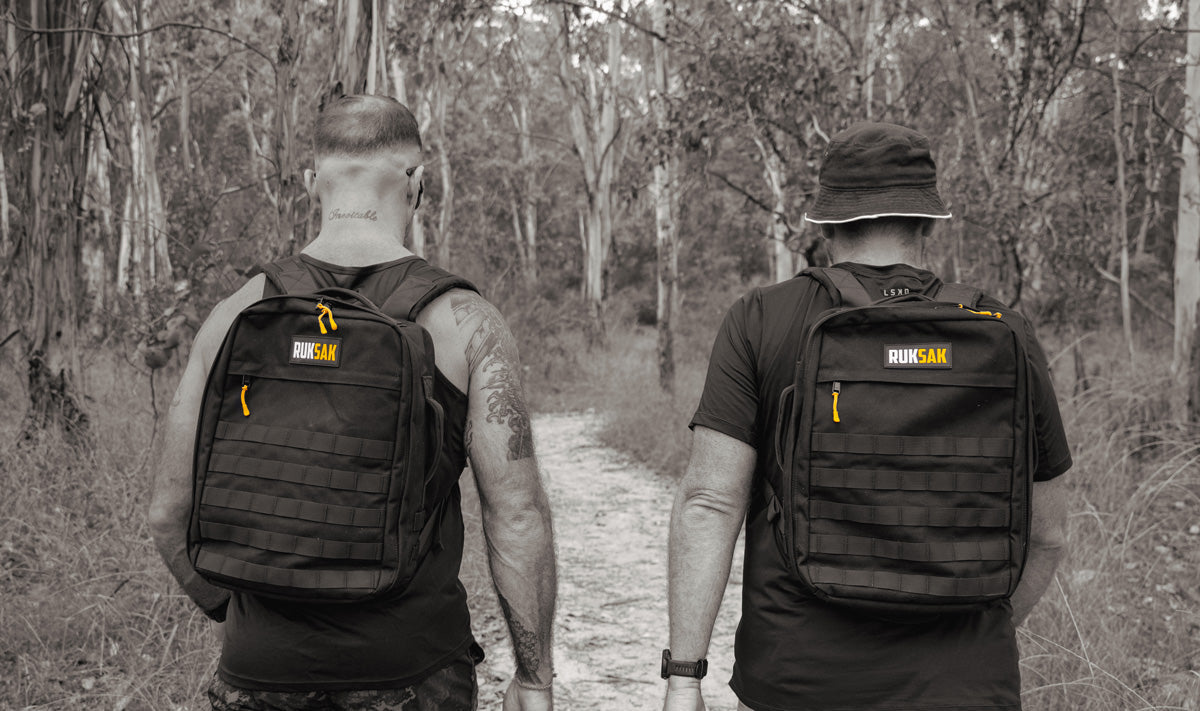
You've decided to add weight to your walks. You've done the research. Rucking is legit. So you go searching for a weighted backpack and suddenly you're staring at a product designed for a Navy SEAL.
That's the problem. And it's bigger than most people realise.
Key Takeaways
- Most weighted backpacks on the market were designed for military training and elite athletes, not everyday fitness
- The biggest design gap isn't weight capacity, it's comfort, adjustability, and usability for normal people
- Even Outside Online recently called out rucking pack brands for failing to take cues from proper outdoor backpack design
- The rucking category is booming, but most of the gear hasn't caught up with the people now using it
- RUKSAK was designed from the ground up for the person who wants to ruck consistently, not compete in a Crossfit event

Rucking Is Going Mainstream. The Gear Hasn't Caught Up.
Rucking (walking with a weighted pack) has exploded. Garmin added dedicated rucking activity tracking to their smartwatches in 2025. Outside Online is writing full review features on it. Suburban walkers, women in perimenopause, gym-goers looking for low-impact strength work, hikers wanting more bang for their kilometre... they're all showing up to the category.
And they're all running into the same wall.
The brands that built the rucking category built it for a very specific person. GoRuck was created by a former Special Forces soldier to train civilians for military-style endurance events. The packs reflect that. Fixed 20-pound plates. Minimal padding. No waist belt on the base model. Cordura construction that'll survive a war zone.
Which is great, if that's who you are. But most people who want to add weight to their morning walk are not training for Kokoda.
The Review That Said What Everyone Was Thinking
In April 2026, Outside Online published a 50-mile side-by-side test of weighted vests and rucking packs. Their verdict on the GoRuck Basic Rucker – one of the most prominent rucking packs on the market – was blunt.
The reviewer walked away wishing for a sternum strap to stabilise the load. She wanted more comfortable shoulder straps. And she concluded, pointedly, that "rucking pack companies could benefit from taking cues from outdoor and running backpacks by using higher-end materials and smarter designs."
That's not a fringe opinion. That's a widely read outdoor publication saying, on the record, that the category has a design problem.
That design problem has a name. And it comes down to who the product was actually made for.
The Three Things Most Weighted Backpacks Get Wrong
1. The weight jumps are too big:
Most plate-based rucking systems offer 5kg plates as the smallest increment. Some start at 10lb (4.5kg). That means your options are: light, or a big jump. For anyone trying to manage heart rate zones, progressive overload, or just not destroy their shoulders in week one, that's a real problem. You either undertrain or overcook it. There's no middle setting.
This is especially relevant for the majority of people now entering the category, women over 40 focused on bone density, people returning from injury, anyone just starting out. Jumping from nothing to 5kg isn't progressive overload. It's a gamble.
2. Comfort is an afterthought
Here's the thing about military gear: it's designed to perform under extreme conditions, not to feel great during a Tuesday morning walk around the park. That distinction matters.
No sternum strap means the load pulls your shoulders back and down, which fatigues the traps and upper back quickly. Rigid plates don't contour to your back, so the load point is a hard edge rather than a distributed surface. And if you're a woman, a pack designed around a male torso geometry is going to fit differently in ways that add up over 5km.
The Outside Online reviewer who walked 50 miles across multiple products, specifically flagged the shoulder strap discomfort and the missing sternum strap. That's not a minor quibble. That's the reason people quit.
3. They're built for heavy, not smart
The legacy rucking pack is optimised for maximum load. The GoRuck plate system can carry up to 45lb (20.5kg). That's the point — progressive challenge for athletes doing structured ruck events.
But for someone whose goal is to build consistent strength, improve bone density, and stay in Zone 2 cardio on their daily walk, maximising load capacity is the wrong metric.
The right metric is: how precisely can you control your weight? How easy is it to add 1kg instead of 5kg? How long can you wear it before discomfort makes you take it off?
Those questions have different answers, and most of the category wasn't designed to address them.

Why We Built RUKSAK the Way We Did
RUKSAK exists because those three problems needed solving for the person rucking has actually reached. The RUKBRIK system is the core of it. Instead of a fixed plate, RUKSAK loads with individual 1kg bricks. You can start at 1kg and work up to 15kg, one kilogram at a time. That's not just a nice feature. It's what makes progressive overload actually work for real people, rather than elite athletes.
It means you can fine-tune your training load to stay precisely in your target heart rate zone. It means a 60-year-old woman building bone density after a DEXA scan can start sensibly and increase safely. It means the pack earns its place in your weekly routine instead of sitting in the corner after three uses.
The rest of the design follows the same logic. Chest strap included. Hip belt included. Hydration pack included. Cordura construction (the same material GoRuck charges a significant premium for) as standard. Because a pack that's uncomfortable, or incomplete, is a pack you won't wear.
The Honest Assessment
Most weighted backpacks on the market were designed for a different person than the one now buying them. That's not a criticism of those brands – they built great products for their audience. But the audience has changed, and the gear needs to reflect that.
If you're training for a GoRuck event or you want to carry 20kg through the Dandenong Ranges, a plate carrier will serve you well. But if you're a person who walks regularly, wants to add weight intelligently, and expects the pack to feel like an extension of your body rather than a punishment – the design has to be different.
That's what RUKSAK was built to be.

Your Next Step
If you've been frustrated by weighted backpacks that feel like too much too fast, or uncomfortable after an hour, or just built for someone else's goals, then explore the RUKSAK here. Start at whatever weight makes sense. Add a brick when you're ready. Walk further, train smarter, and actually use the thing. That's the whole idea.



Share:
How To Get The Most Out Of Your RUK Gear In Bad Weather
STRYDR: the weighted vest built for how you actually train