


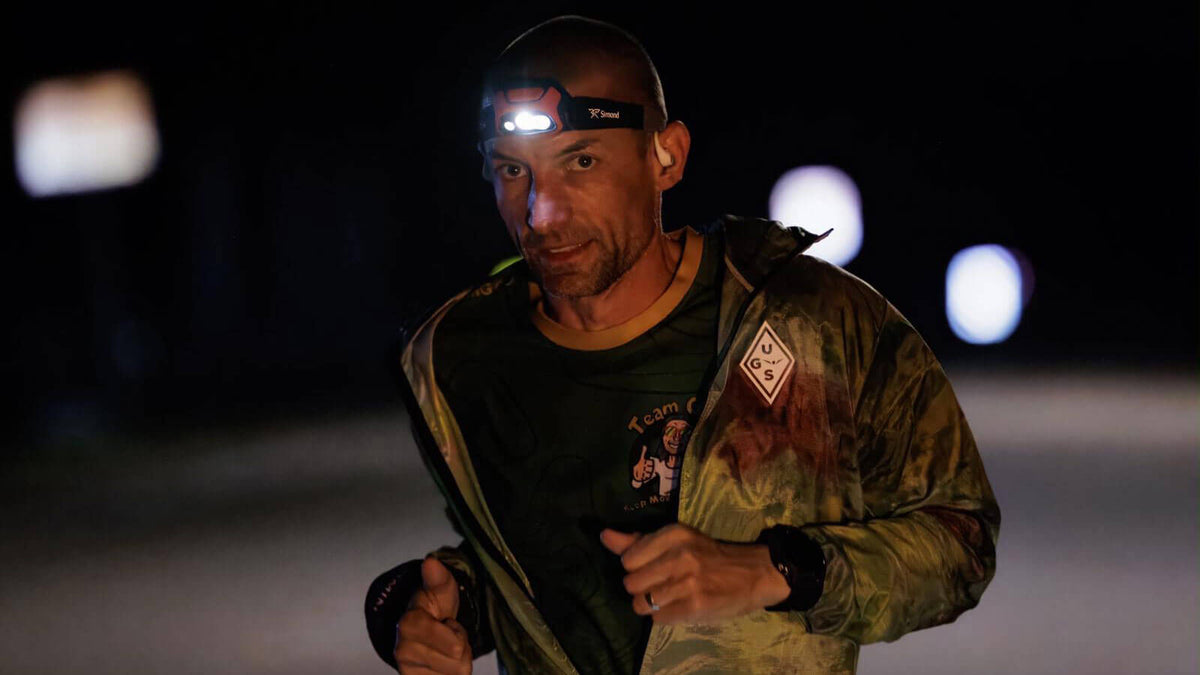
If you've never heard of Phil Gore, that's totally fine. Most Australians haven't. But its a bit of a crime, because my mate Phil is a Perth firefighter and father of four. He's also the best backyard ultra runner on the planet.
He holds the world record.
He's the reigning world champion.
He's won 14 of the 16 backyard ultras he's ever entered.
And until a few weeks ago, nobody, including Phil, had any idea how far he could actually go.
This is the story of how we found out.
First, what on earth is a backyard ultra?
It's the simplest and most brutal format in running. You run a 6.71 km loop, called a "yard", and you have one hour to finish it. Whatever time is left over is yours to eat, stretch, sleep or cry. Then the bell goes and you do it again, every hour on the hour, until only one person is left standing.There's no finish line. The last runner still going wins.
Phil set the world record at Dead Cow Gully in Queensland in June 2025, running 119 yards, nearly 800 km over almost five days. A few months later he flew to Tennessee for Big's Backyard Ultra, the world championships, and beat the best backyard ultra runners in the world with 114 yards.
The problem with being the GOAT
Here's the strange thing about the format. You only ever go as far as the person who comes second.
The runner-up is called your "assist". The moment your assist taps out or times out, you run one more yard on your own and the race is over. You win. Everyone goes home.
That's great for a trophy, but terrible for finding out what you're made of. At Big's, Phil may well have had another day left in his legs, and nobody will ever know. Every time he's won, the race has ended before he did.
Phil told me he just wanted to know where his limit was, and he didn't think anyone in that format could ever push him there.

Credit: Chris Osborne
From "No Assist" to Project 168
The original idea was called No Assist. Phil would keep running every hour on the hour, with no competitors, until his body said no.
Real life got in the way, as it does. There's work, family and the people crewing for him. So we put a cap on it of seven days, which is 168 hours. If he got through every yard, that would be roughly 1,127 km.
That's how No Assist became Project 168.
On Sunday 23 August, at Alfred Skeet Reserve in Forrestdale, just outside Perth, the bell rang for yard one. There was a day loop, a night loop and one man versus the clock.
The rollercoaster
What surprised me most wasn't the distance. It was the swings.
On day four I did an ABC radio interview. I told them Phil looked fantastic and he was a shoo-in to go all the way. Not ten minutes after I hung up, I got a message from the team saying he was really struggling and the end might be close.
Then he came good again, for a few hours, then half a day, then a whole day. Then he'd drop, and then he'd claw his way back. If you've never watched someone do this, it's hard to explain how much of it is a battle inside his own head. He was sleeping in blocks of about 10 minutes at a time for nights on end, eating whatever his body would accept, and then standing up and going again.
The community was incredible too. People came out to run laps with him and to sit with the crew through the night. They wanted to be part of something they knew they'd never see again.

Credit: Gabby Villa
Yard 152
I'll be honest. By the end, I wanted him to stop.
He was in a huge amount of pain. But the job of a support crew in this sport is to keep the runner moving forward, so that when it's over there are no "what ifs". No post-race regret. So they kept getting him up, and he kept going out.
Eventually his body made the call for him. Phil completed 152 yards, more than 1,000 km, before he couldn't finish a lap inside the hour.
He was 16 short of 168. But he went 33 yards past his own world record. For context, the next-best effort in history is the 118 that Sam Harvey ran as Phil's assist when Phil set that record.
It won't go in the official record books, because backyard records need another runner on the course. We ran it exactly like an official event, down to the letter, and everyone in the sport knows what he did.
The cost
What finished him was a haematoma in his left thigh. In the week after, it got infected and Phil was in and out of hospital. Doctors drained 500 ml of fluid from it, and he still needed surgery. He's recovering now and can't run yet.
That's the reality of finding your limit. It isn't a highlight reel. It hurts, and it keeps hurting after the cameras go off. Credit: Chris Martin
Why Telethon
Phil ran the whole thing to raise money for Telethon. His dad used to work with them. Telethon supports the Perth Children's Hospital, which has helped Phil's own kids over the years. In WA it's simply an iconic charity.
Our target was $168,000, one dollar for every... well, you get it. We thought that was a massive stretch. During the week of the run alone, Phil raised around $280,000.
We've kept going since then. Telethon has been running for around 50 years, and this weekend we're aiming to reach $300,168. That would make Phil the biggest individual challenge fundraiser in its history. A world record on the track and a Telethon record off it. You can make your own donation here.
Where we come in
I first met Phil when I asked him to be a mentor on my show, Search4Hurt. We've become great mates since. So when he asked for support on Project 168, it was an easy yes. We sponsored the event and filmed the whole week for a documentary.
There's a practical connection too. A backyard ultra involves a lot more walking than people think, and Phil trains for that with our weighted vest. He uses it in his walk training before the event. Now that he can't run, it's become a big part of his rehab. He reckons it spices up what would otherwise be a pretty boring walk for a guy who runs so far.
 Credit: Gabby Villa
Watch how it unfolded
Phil's story even made its way onto Joe Rogan's podcast. Most people still have no idea who he is, though, and I'd love to change that.
The documentary I made of his effort, Project 168, premiered on YouTube at 6:30pm AEDT on Saturday 17 October (3:30pm in Perth) on our, The Search AU channel www.youtube.com/@thesearchAU … which has all my TV show episodes as well.
Go and watch it. It's not really a film about running. It's about a bloke who'd already beaten everyone in the world and still needed to know how far he could go.
Now he knows. And so will you.
Adam
--
Title Image Credit: Gabby Villa

Share:
Can You Run With a Weighted Vest or Backpack? What the Research Actually Says